Warm Fuzzy Story Club
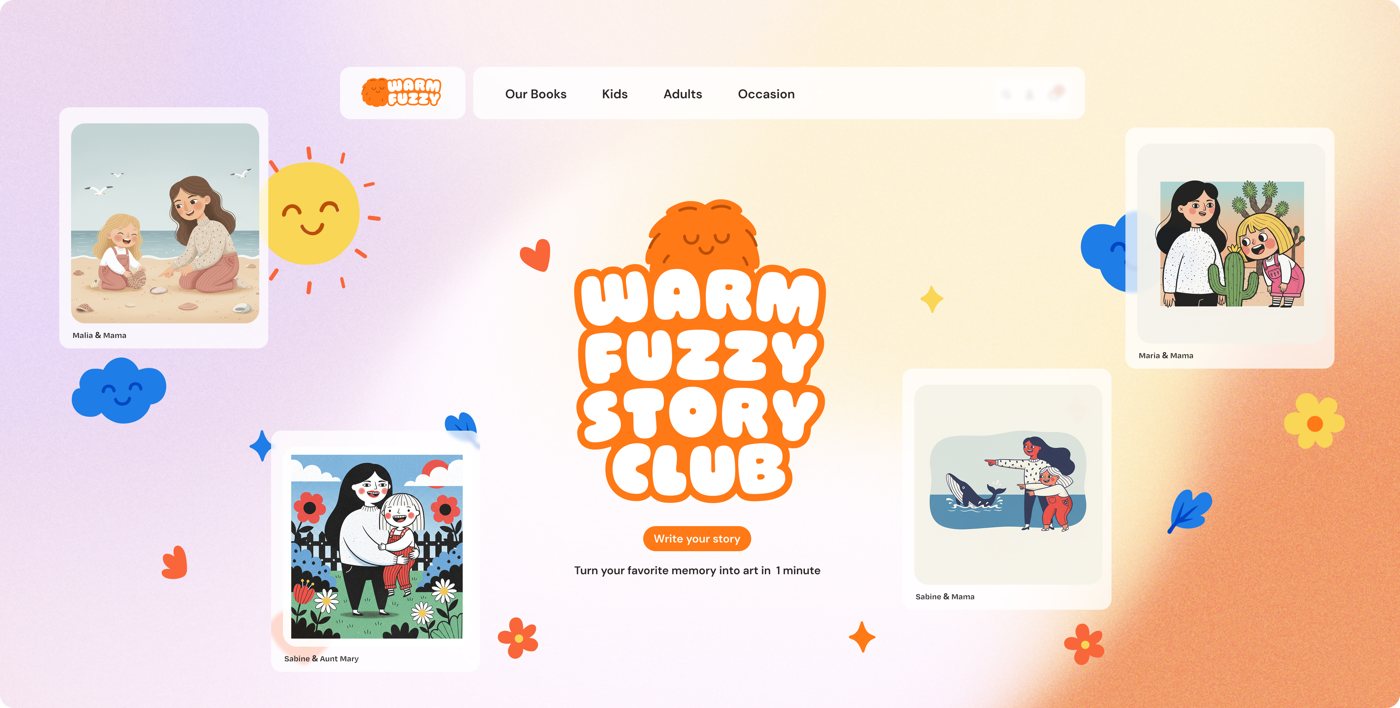
Warm Fuzzy Story Club turns a family memory into a designed picture book. You upload a few photos, describe your story in a couple of sentences, and a printed book comes back with your people in it. A trip to the zoo with Papa becomes a book about that trip to the zoo with Papa, where both of you are recognizably yourselves on every page, drawn in a style an artist designed.
My wife and I built it end to end, and we built it with artists. Every illustration style is a collaboration with an illustrator, who art-directs how families are drawn in it and shares in every book sold in their style. The models handle the repetition of keeping the same faces across thirty pages. The taste, and the income, stay with the artists.
Under it sits a pipeline we built ourselves. A likeness system turns the photos into characters, a story engine expands the short description into a paged narrative, and the finished book arrives print-ready. The whole chain runs without anyone touching the file, which was the point and also the hardest constraint.
Consistency is the product
Generating one lovely image was never the hard part. The hard part is page six, where the same faces, the same clothes and the same style still have to be recognizable. Most of our engineering went into keeping characters stable across a whole book, and most of our taste went into rejecting pages that were technically fine but not quite the people. Every book in our test set exists in several versions because of that bar.
We also decided early that the output is paper. A generated story you swipe through disappears with the feed, while a printed book gets read at bedtime again and again. Making the end of an AI pipeline a physical object raised the bar for quality, because a book with a wrong face in it doesn't get quietly regenerated. It gets noticed by a four-year-old.
The Austrian Chamber of Commerce shortlisted it as a finalist for digital innovation.
Of everything we've built with AI, this is the one I'd point to for the word empathetic. The models did the drawing. Deciding what a family will want to hold in their hands in twenty years stayed a human job.